


Page 12 - MG_Magazine 22ED_WEB
P. 12
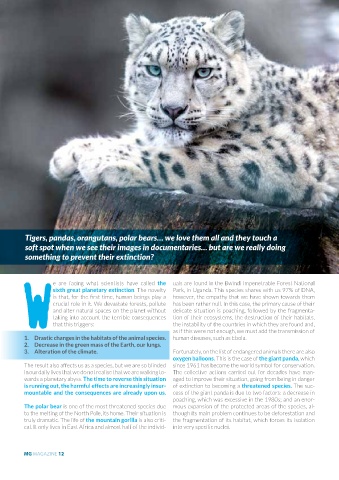
Tigers, pandas, orangutans, polar bears… we love them all and they touch a
          soft spot when we see their images in documentaries… but are we really doing
          something to prevent their extinction?


                    e are facing  what  scientists  have called  the   uals are found in the Bwindi Impenetrable Forest National
                    sixth great planetary extinction. The novelty   Park, in Uganda. This species shares with us 97% of DNA,
                    is that, for the first time, human beings play a   however, the empathy that we have shown towards them
                    crucial role in it. We devastate forests, pollute   has been rather null. In this case, the primary cause of their
                    and alter natural spaces on the planet without   delicate situation is poaching, followed by the fragmenta-
                    taking into account the terrible consequences   tion of their ecosystems, the destruction of their habitats,
         Wthat this triggers:                                 the instability of the countries in which they are found and,
                                                              as if this were not enough, we must add the transmission of
          1.  Drastic changes in the habitats of the animal species.  human diseases, such as Ebola.
          2.  Decrease in the green mass of the Earth, our lungs.
          3.  Alteration of the climate.                      Fortunately, on the list of endangered animals there are also
                                                              oxygen balloons. This is the case of the giant panda, which
          The result also affects us as a species, but we are so blinded   since 1961 has become the world symbol for conservation.
          in our daily lives that we do not realise that we are walking to-  The  collective actions  carried  out  for decades  have man-
          wards a planetary abyss. The time to reverse this situation   aged to improve their situation, going from being in danger
          is running out, the harmful effects are increasingly insur-  of extinction to becoming a threatened species. The suc-
          mountable and the consequences are already upon us.  cess of the giant panda is due to two factors: a decrease in
                                                              poaching, which was excessive in the 1980s; and an enor-
          The polar bear is one of the most threatened species due   mous expansion of the protected areas of the species, al-
          to the melting of the North Pole, its home. Their situation is   though its main problem continues to be deforestation and
          truly dramatic. The life of the mountain gorilla is also criti-  the fragmentation of its habitat, which forces its isolation
          cal. It only lives in East Africa and almost half of the individ-  into very specific nuclei.


         MG MAGAZINE 12

