


Page 37 - MG_Magazine 22ED_WEB
P. 37
These green solutions are not only good for our
                                                              health and the environment, but they are also very

                                                                  attractive and beautify cities. Discover the
                                                                   exciting vertical world of the city plants.


                                                                  t is clear that we are happier in a green environment
                                                                  than in a grey one and that we like to admire nature,
                                                                  even  more  so  if  the  garden  in  question  surprises  us
                                                                  with its verticality. For a few years now, the main cit-
                                                                  ies of the world have begun to wear green. They need
                                                                  lungs and parks are privileged spaces that are current-
                                                                  ly taken care of, but they are not enough. In this con-
                                                             Itext, new prototypes of vertical gardens gain strength.
                                                              Large cities are becoming more vertical and space is scarce,
                                                              so the idea of taking advantage of the walls of buildings to
                                                              cultivate gardens is most promising. Its benefits are many.
                                                              To start with, they help purify the air, absorb and reduce
                                                              noise  and also  lower  the  ambient  temperature, since
                                                              plants absorb 50% of sunlight and reflect 30%.

                                                              Plants in a vertical garden can filter particles from the air
                                                              and convert CO2 into oxygen. 1 m2 of green facade ex-
                                                              tracts 2.3 kg of CO2 per year from the air and produces
                                                              1.7 kg of oxygen.

                                                              Vertical gardens can be exterior or interior. In closed en-
                                                              vironments they allow the saving of air conditioning in sum-
                                                              mer and a considerable increase in the feeling of well-being.
                                                              For example, in an office they have a very positive effect on
                                                              people's moods, improving their health. It is proven that they
                                                              reduce complaints, fatigue, sore throats and headaches and
                                                              even eye irritation typical of the use of screens.
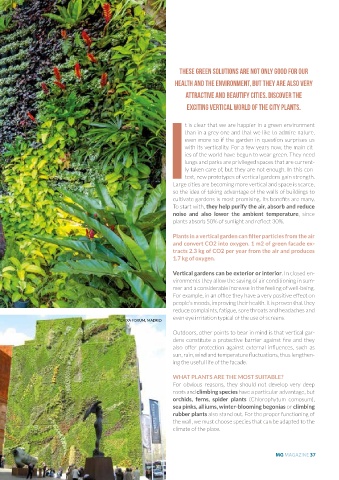
                                           caixa forum, madrid
                                                              Outdoors, other points to bear in mind is that vertical gar-
                                                              dens  constitute  a  protective  barrier  against  fire  and  they
                                                              also  offer  protection  against  external  influences,  such  as
                                                              sun, rain, wind and temperature fluctuations, thus lengthen-
                                                              ing the useful life of the facade.

                                                              WHAT PLANTS ARE THE MOST SUITABLE?
                                                              For obvious reasons,  they should not develop very deep
                                                              roots and climbing species have a particular advantage, but
                                                              orchids,  ferns,  spider  plants  (Chlorophytum  comosum),
                                                              sea pinks, alliums, winter-blooming begonias or climbing
                                                              rubber plants also stand out. For the proper functioning of
                                                              the wall, we must choose species that can be adapted to the
                                                              climate of the place.


                                                                                                  MG MAGAZINE 37

